

This book…
Embraces one guiding word to concentrate effort for yearlong growth across life and ministry.
- Why this matters: This book focuses heart before habits in discipleship and counsel.
- Who it’s for: This book equips small‑church pastors and lay leaders to pursue focused change.
- Between the lines: This book risks oversimplifying formation and underusing Scripture tests.
- At a glance: 112 pages • 2013 • Personal Growth • Easy • 4.22/5
Britton, Page, and Gordon argue that choosing one word clarifies attention and aligns daily practice. They commend communal accountability and visible reminders while urging a shift from scattered resolutions to focused formation. Their core claim: simplicity channels change over a full year.
One Word, Whole Life: A Year of Focus
Right before I was going to experience one of my most difficult years, I heard an interview on a podcast where Jon Gordon, one of the authors, shared the transformation through the one-word framework instead of a complex list of resolutions. Since then, I have employed this system for over a decade! It will be worth your time to gain clarity in your life by choosing one word for the year.
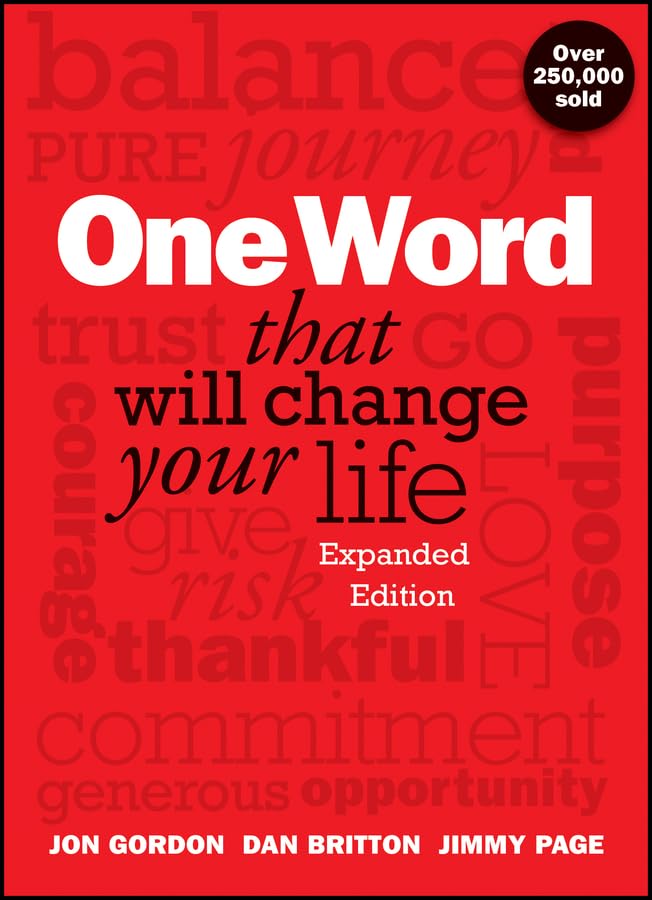
Structure
The authors build around a three‑step arc: look in, look up, look out. First, preparation creates silence and honest questions that surface a need. Next, discovery attends to patterns in prayer, conversations, and readings until a word emerges. Finally, practice lives the word through reminders, simple rhythms, and a “Stretch Team” for accountability. The six-dimensional lens—spiritual, physical, mental, relational, emotional, and financial—ensures balanced application in daily life.
Evaluation
The book is strongest where it insists that change begins in the heart and grows through attention over time. “Be” and “do” must stay integrated; identity and practice mature together. To anchor discernment, test any word by Scripture, wise counsel, and observable fruit. “Be not conformed to this world: but be ye transformed by the renewing of your mind” (Romans 12:2) provides the right baseline for focus. Treat the word as a means, not a mandate.
Strengths
Simplicity lowers friction and sustains attention. A single constraint acts like a lens, concentrating effort. Communal sharing—your Stretch Team—adds durable accountability. The process invites weekly reviews and visible cues, which translate easily into small‑church rhythms. The yearlong horizon reframes “wins” and “losses” as formation, not scorekeeping. The balanced life‑domain grid discourages lopsided growth.
Cautions
At times, the rhetoric overspiritualizes discovery and delays explicit biblical testing. Statistics about failed resolutions appear without sources. Guidance on accountability cadence and measurement could be more precise. Readers should integrate Scripture pairing, counsel, and gentle metrics that avoid legalism while noticing grace‑driven change.
Quotations
- “Most resolutions are long forgotten by summer… We derail and give up.” (p. 5)
- “A life focused with One Word becomes a force that can cut through the status quo.” (p. 6)
- “Prepare your heart… look in; discover your word… look up; live your word… look out.” (p. 7)
Takeaways
Treat one word as a simple, steady constraint that clarifies attention and shapes practice. Begin by pairing your word with a single verse to memorize, then add one weekly habit that embodies it. Share the word with a small Stretch Team and keep a brief Friday review to note grace at work and the next faithful step. Use visible cues where attention lives so the word stays present in ordinary moments. Choose a fresh word each year so growth remains humble, scripture‑tested, and focused rather than mechanical.
Conclusion
One Word That Will Change Your Life offers a focused framework for ordinary formation in real ministry time. It excels by simplifying discipleship to a single word, keeping heart transformation before behavior, and supplying usable practices such as visible reminders, weekly reviews, and a small “Stretch Team” across the six life dimensions.
However, it sometimes oversimplifies the complexity of spiritual growth and leans on unsourced statistics; discovery language can feel subjective unless anchored by Scripture and wise counsel. Those limits are manageable when readers test their word by the Word, establish an accountability cadence, and watch for observable fruit.
You can implement this approach by prayerfully selecting one word, pairing it with a verse to memorize, and adding one weekly habit that embodies it. Share the word with a small team, place cues where attention lives, keep a brief Friday review, and choose a fresh word each year so growth stays humble and non‑mechanical.
I have returned to this book several times. I believe it will serve small‑church pastors and lay leaders who want grace‑driven change with clarity and calm focus.
