

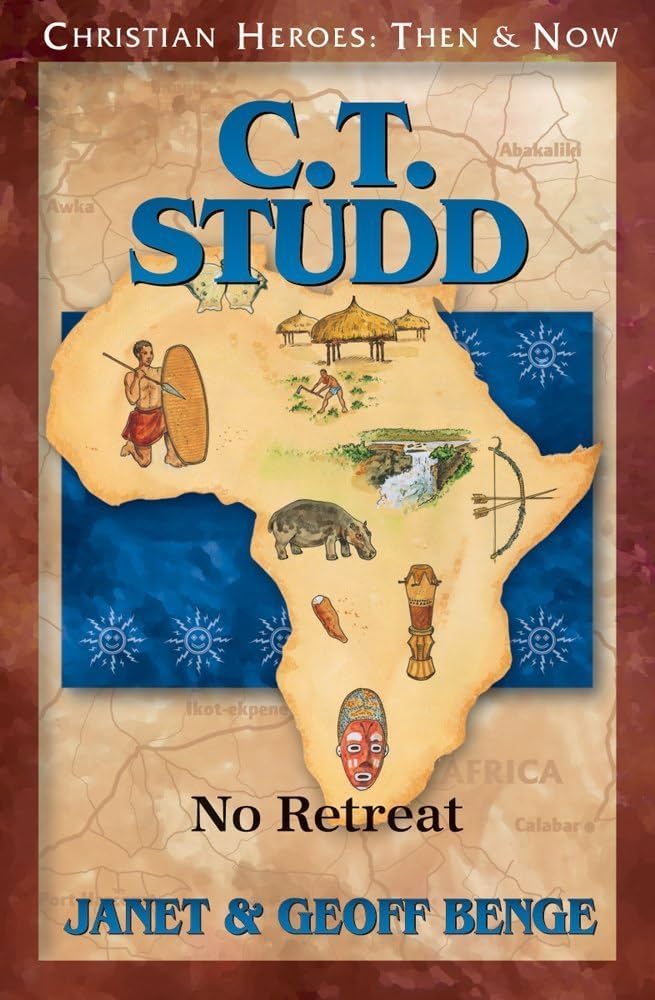
C. T. Studd: No Retreat by Janet and Geoff Benge follows C. T. Studd from English cricket fame to front‑line mission work in China, India, and the heart of Africa. Readers watch how Christ redirects comfort, calling, and cost through one imperfect but wholehearted servant. Along the way, families and church leaders gain a vivid picture of costly obedience that exposes “chocolate soldier” Christianity while still calling for wisdom and love.
This book…
Shows how Christ reshapes comfort, calling, and cost through one man’s “no retreat” obedience.
- Why this matters: Confronts comfortable Christianity with concrete pictures of costly discipleship.
- Who it’s for: Helps families, students, and church members imagine wholehearted missions in ordinary life.
- Between the lines: Honors bold obedience, but watch how rigid expectations can become impositions instead of inspirations.
- At a glance:
- Pages: 192
- Published: 2005
- Genre: Missionary biography (Christian Heroes series)
- Difficulty: Easy
- My Rating: 4.5/5
Transform Comfort Into Costly Obedience
I first met C. T. Studd in scattered missionary stories, usually as the man who gave away a fortune and marched into hard places. I picked up C. T. Studd: No Retreat because I needed my own heart stirred again toward costly obedience, not just inspired phrases. Reading it in the middle of ministry transitions, I found myself walking with him from English cricket fields to inland China, plantation rows in India, and remote villages in the Congo. The Benges give younger readers a front‑row seat to a man who took Jesus’ call seriously, even when his choices exposed sharp edges and blind spots. This review aims to help ordinary believers receive the fire without swallowing the fumes.
Overview
This biography traces C. T. Studd’s story from his wealthy English upbringing and cricket stardom through conversion, missionary service in China and India, and trailblazing work in central Africa. In accessible, junior‑level prose, the authors show how God turned a national sports hero into a missionary who refused to retreat. Key scenes—his surrender of an inheritance, long sea voyages, village unrest, and jungle treks—give concrete flesh to themes we often treat as abstractions: cross bearing, stewardship, and mission.
Structurally, the book moves in a mostly chronological path, anchored by decisive turning points. A brother’s illness forces C. T. to ask what is truly worthwhile. A single sermon at a China Inland Mission meeting redirects his future toward the “heathen” for his inheritance. Legal documents and signed checks prove that his conviction, “If Jesus Christ be God and died for me, then no sacrifice can be too great for me to make for Him,” was more than a slogan. Later chapters follow his marriage to Priscilla, the birth and loss of children, the opening of an opium refuge, and the launch of Heart of Africa Mission (later WEC). The pattern is clear: crisis, prayer, costly obedience, and surprising provision.
Theologically, the biography is warmly evangelical and missions‑minded rather than systematic. The Benges highlight C. T.’s confidence in God’s sovereignty and provision, his passion for the lost, and his conviction that life must match profession. At the same time, some of his decisions invite careful evaluation in light of the whole counsel of God. Texts like, “One that ruleth well his own house, having his children in subjection with all gravity,” remind us that gospel leaders must model godliness at home as well as abroad (1 Timothy 3:4). “And the servant of the Lord must not strive; but be gentle unto all men, apt to teach, patient,” presses us to pair zeal with patience and kindness (2 Timothy 2:24). Read this book with an open Bible and a willingness to honor his faith while weighing his choices.
Strengths
One of this book’s chief strengths is its accessibility. Short chapters, clear language, and vivid scenes make it easy to read aloud in family devotions or youth groups while still offering substance for adults. Children can picture cricket matches, crowded meetings with D. L. Moody, river journeys into inland China, and a white wedding in the Congo. Parents and teachers gain ready‑made illustrations for sermons, lessons, and conversations about missions.
A second strength lies in the way the biography showcases radical generosity and obedience in concrete terms. C. T. does not merely speak about trusting God with finances; he signs legal papers and empties accounts. He does not simply admire missionaries; he sails to hard places and stays when doors close around him. These episodes give living color to themes like counting the cost, laying up treasure in heaven, and treating resources as a trust instead of a cushion.
The book also excels at showing how God works through partnerships. The portrait of Priscilla as a true helpmeet—“United to fight for Jesus”—pushes against the idea that missions is a solo performance. Stories of the Cambridge Seven, Chinese believers like Pastor Shi, African converts such as Sambo, and later co‑laborers in WEC remind us that God builds His work through teams, not isolated heroes. That makes this biography especially helpful for teaching about shared ministry, mutual encouragement, and the importance of sending and supporting roles.
Cautions
At the same time, this biography raises important cautions that thoughtful readers should name. First, the natural limits of a concise, youth‑oriented series create some structural bumps. Time markers can be uneven. Some chapters anchor events with specific dates, while others let months or years pass without clear signals. Occasional previews of future events, followed by backtracking to fill in details, can momentarily blur the storyline.
The biography bears the most fruit when paired with teaching that distinguishes between self‑indulgent ease and sober‑minded stewardship of body, family, and flock.
More significantly, some of C. T.’s choices—especially regarding his family and co‑workers—must be weighed carefully against Scripture. In an era when long separations in mission work were common, he nonetheless embraced patterns that sit uneasily beside the call to one “that ruleth well his own house, having his children in subjection with all gravity” (1 Timothy 3:4). His insistence on a harsh, spartan lifestyle for others sometimes crossed from example into imposition, creating division and discouragement among those who had already sacrificed much. The book hints at these tensions but rarely pauses to evaluate them, so parents, pastors, and disciplers will need to supply that reflection.
Finally, his famous rhetoric about “chocolate soldiers” is powerful but easily misapplied. Without pastoral guidance, younger readers might equate wisdom, rest, or faithful presence at home with cowardice. The biography bears the most fruit when paired with teaching that distinguishes between self‑indulgent ease and sober‑minded stewardship of body, family, and flock.
Quotations
- “If Jesus Christ be God and died for me, then no sacrifice can be too great for me to make for Him.” (p. 145)
- “Some want to live within the sound of church or chapel bell; I want to run a rescue shop within a yard of hell.” (p. 173)
- “We can trust God too little, but we can never trust Him too much.” (p. 188)
Takeaways
For my own life and for those I shepherd, this biography presses several concrete actions. Examine where comfort has quietly replaced calling; that may not mean crossing oceans, but it will mean crossing the street, opening the home, and reordering finances for the kingdom. Revisit stewardship by treating resources as a trust, not a cushion, letting costly generosity train the heart to say, “The earth is the LORD’S, and the fulness thereof; the world, and they that dwell therein” (Psalm 24:1). Cultivate a missionary imagination in the home through stories, prayer for laborers, and a table that welcomes those on the front lines. Finally, pursue zeal that walks with wisdom—seeking counsel, guarding the family, and remembering that the Lord delights in faithful plodders as well as trailblazers.
Conclusion
C. T. Studd: No Retreat by Janet and Geoff Benge offers a lively, faith‑stirring portrait of a man who refused to play at Christianity, turning privilege into a platform for sacrificial mission. Its structural unevenness and limited critique of C. T.’s excesses mean it is best read with an open Bible and pastoral discernment, especially when applied to family life and leadership. Used that way, it can serve as a rich devotional companion and a well of missionary illustrations for families, small groups, and local churches who long to move from “chocolate soldier” comfort to wise, wholehearted obedience.
Related Material
- Contextualizing the Cross: Faithful Discipleship Defined — sharpens Studd’s example by clarifying where true cross‑bearing ends and cultural compromise begins.
- Powerful Prayers for Missionaries: Weekly Focus Guide — turns the biography’s missionary burden into specific, weekly intercession for those now serving.
- Divine Calling in Everyday Work — grounds costly obedience in ordinary vocations so readers can apply Studd’s lessons without romanticizing overseas missions only.
